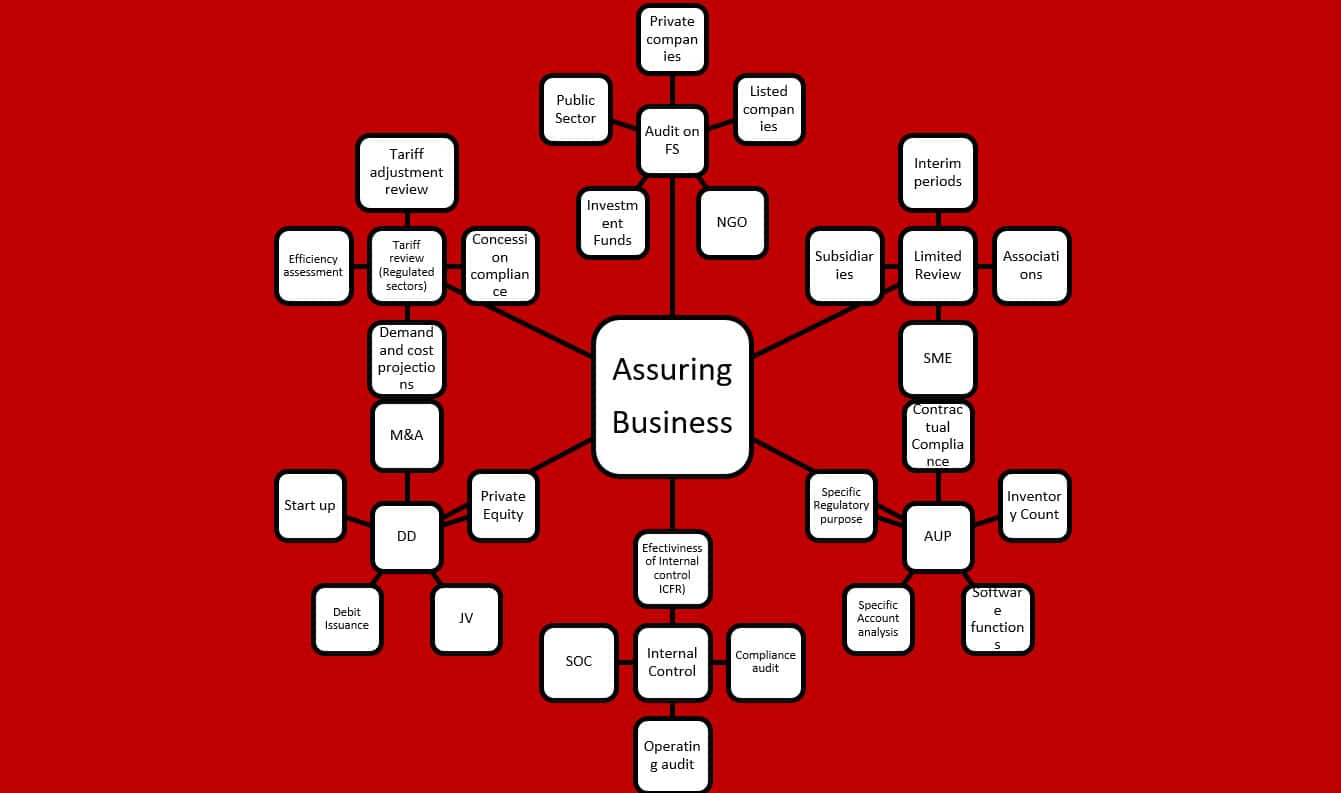
Assuring Business

By providing top-tier attestation-assurance services, our expert team delivers comprehensive audits, reviews and other attestation services, ensuring finance, data and procedures are accurate, reliable and compliant with all relevant aspects. With commitment to integrity and precision we help companies build trust and make informed business decisions confidently.


Financial Statement Audit (FS Audit):

  • Listed companies – Mandatory under regulations to protect investors and ensure transparency in the capital markets.
  • Private companies – May be requested by banks for loan applications, by potential buyers in mergers and acquisitions, or by shareholders to increase confidence in management.
  • Non-Governmental Organizations (NGOs)- Often required by donors and funding agencies to ensure the proper use of funds.
  • Public sector entities – In many countries, government bodies and state-owned enterprises are subject to audits to ensure accountability and transparency in the use of public funds.
  • Pension plans and investment funds – To ensure that assets are being managed appropriately and that financial information is reliable for beneficiaries and investors.

Financial Statement Review (Review)

  • Small and medium-sized enterprises (SMEs) – Can be a more cost-effective alternative to an audit, providing a reasonable level of assurance to banks or other stakeholders.
  • Growing companies –  Before a full audit becomes necessary or feasible, a review can provide useful insights into the company’s financial health.
  • Subsidiaries of larger companies – The parent company may request reviews of its subsidiaries’ financial statements for monitoring and consolidation purposes.
  • Condominiums and associations – To provide a certain level of confidence to members regarding financial management.
  • Interim periods (e.g., quarterly reviews) –  Publicly traded companies may conduct reviews of their quarterly results before the annual audit.

Agreed-Upon Procedures (AUP)

  • Inventory verification –  A bank may request an AUP to confirm the existence and condition of a client’s inventory as collateral for a loan.
  • Specific accounts payable analysis –  A company may hire an auditor to verify the accuracy of a particular group of accounts payable before a significant payment.
  • Compliance with contractual clauses –  A landlord may request an AUP to verify that a tenant is complying with certain financial clauses of a lease agreement.
  • Verification of royalty calculations –  An intellectual property owner may hire an auditor to verify the royalty calculations paid by a licensee.
  • Review of specific information for regulatory purposes –  A company may hire an auditor to perform specific procedures required by a regulatory body.

Due Diligence (DD)

  • Mergers and Acquisitions (M&A)- A buyer conducts DD to assess the assets, liabilities, risks, and opportunities of the target company before completing the transaction.
  • Private Equity and Venture Capital investments – Investors conduct DD to evaluate the viability, growth potential, and risks of a company before investing capital.
  • Real estate acquisition – Investors or companies may conduct DD to verify the legal, environmental, and physical status of a property before purchase.
  • Strategic partnerships and joint ventures – Companies may conduct DD on a potential partner to understand their financial situation, reputation, and operational capabilities.
  • Debt issuance –  Creditors may conduct DD on the borrower to assess their ability to repay and the risks associated with the loan.
  • Others – Pleaser refer to our ‘Growing Business Seccion’ for more details about DD

Assurance on Internal Controls

  • Reports on the effectiveness of internal control over financial reporting (ICFR) – Required by regulations like SOX for publicly traded companies, aiming to increase confidence in the reliability of financial statements.
  • Information system security assessment –  Companies seek assurance on the effectiveness of their cybersecurity controls to protect data and systems from threats.
  • Compliance audit –  Assessment of controls implemented to ensure the organization operates in accordance with laws, regulations, and internal policies.
  • Operational efficiency assessment –  Assurance on the controls and processes implemented to ensure the efficiency and effectiveness of the organization’s operations.
  • Service Organization Controls (SOC) reports – Service providers obtain SOC reports to assure their clients about the suitability and effectiveness of the controls at their service organization that may affect the clients’ data or operations.

Tariff Reviews (Regulated Sectors)

  • Analysis of tariff calculation methodology – Regulatory agencies or independent experts verify whether the methodology used by concessionaires complies with regulations and concession agreements.
  • Verification of efficient costs and investments made – Assessment of whether the costs included in the tariff base are considered efficient and whether the planned investments have been made according to contractual terms.
  • Compliance audit with the terms of the concession agreement – Verification of whether the concessionaire is complying with the financial, operational, and service quality clauses established in the agreement.
  • Evaluation of demand projections and future costs – Analysis of the reasonableness and assumptions used in demand and cost projections that underpin future tariffs.
  • Analysis of tariff adjustment and review mechanisms -Verification of the correct application of annual adjustment mechanisms and periodic tariff reviews, as предусмотрено in contracts and regulations.

Work Group International

How can we help you?